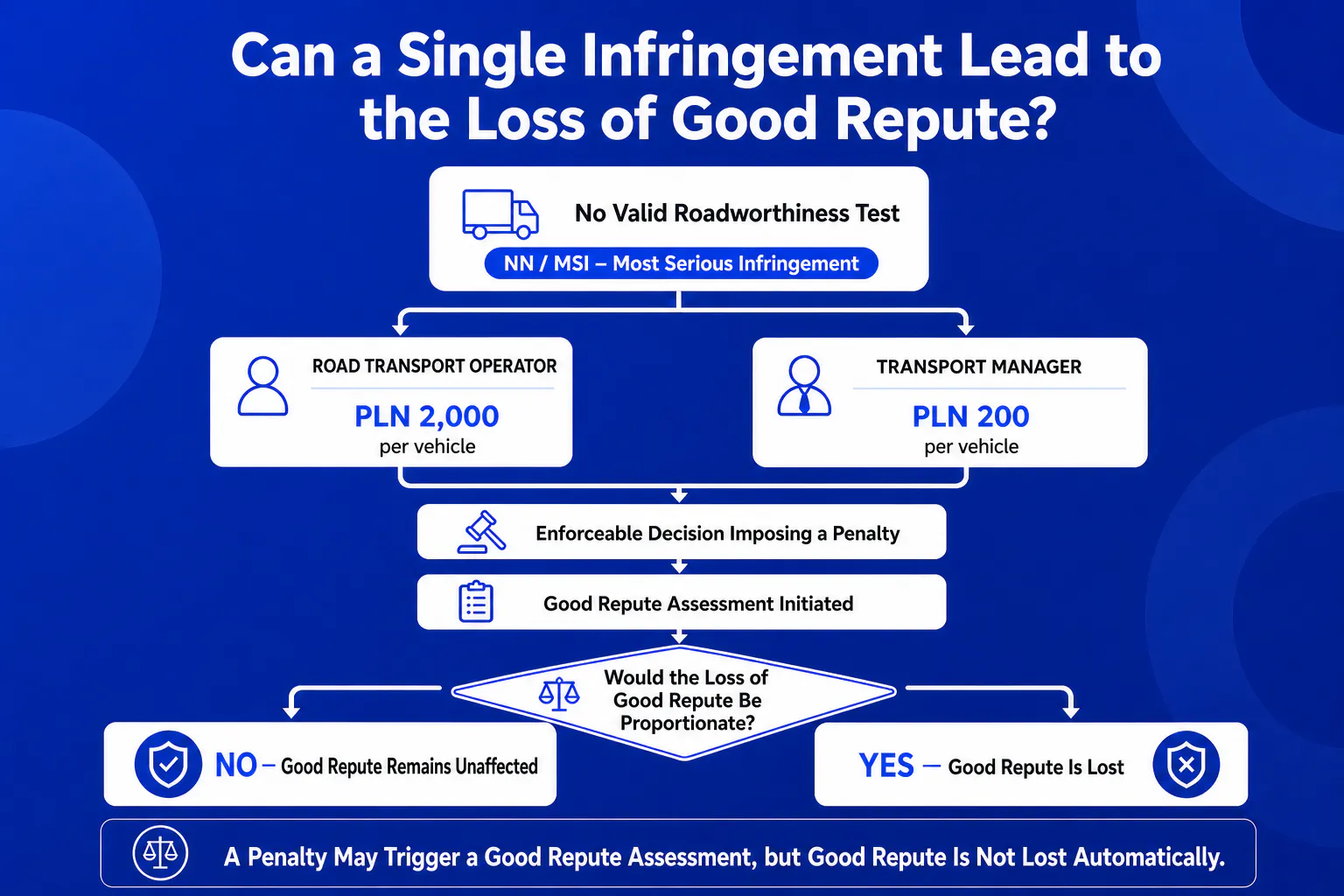
Using a vehicle without a valid roadworthiness test for road transport operations may have consequences extending beyond a financial penalty. Both the road transport operator and the transport manager may be held liable, and the infringement may lead to good repute assessment proceedings.
However, the initiation of such proceedings does not automatically result in the loss of good repute. The competent authority must assess each case individually.
Table of contents
- Who Is Liable for Using a Vehicle Without a Valid Roadworthiness Test?
- What Penalties May Be Imposed?
- Can a Single Infringement Trigger Good Repute Assessment Proceedings?
- Is Good Repute Lost Automatically?
- What Should Be Done After an Infringement Is Discovered?
- How Can the Risk of Similar Infringements Be Reduced?
- Frequently Asked Questions
Who Is Liable for Using a Vehicle Without a Valid Roadworthiness Test?
When a vehicle without a valid roadworthiness test is used for road transport operations, liability may apply to both the road transport operator and the transport manager. Their liability is assessed separately.
The same incident may therefore result in two separate administrative proceedings:
- one against the road transport operator;
- another against the transport manager.
This does not constitute double liability for the same infringement. In the case of the operator, the authority assesses the undertaking’s responsibility for organising road transport operations. In the case of the transport manager, it considers whether that person properly performed their assigned duties.
The specific consequences depend on the person held liable and the legal classification of the infringement.
What Penalties May Be Imposed?
The following penalties may apply when road transport operations are carried out using a vehicle without a valid periodic roadworthiness test:
Responsible party | Penalty |
|---|---|
Road transport operator | PLN 2,000 for each vehicle |
Transport manager | PLN 200 for each vehicle |
In both cases, the infringement is classified as a most serious infringement.
The PLN 2,000 penalty imposed on the operator is not selected from a specified range. If the relevant infringement is established, this amount applies to each vehicle without a valid roadworthiness test.
Can a Single Infringement Trigger Good Repute Assessment Proceedings?
Yes. If the infringement is classified as a most serious infringement and an enforceable administrative decision imposing a penalty is issued, a single incident may be sufficient to initiate good repute assessment proceedings.
The infringement does not need to be repeated, nor does a particular number of infringements need to be reached. Proceedings may be initiated against the road transport operator, the transport manager or another person responsible under the applicable legislation.
Is Good Repute Lost Automatically?
No. Neither the imposition of a penalty nor the initiation of good repute assessment proceedings automatically means that the road transport operator or transport manager will lose their good repute.
The competent authority must assess the circumstances of the case, including:
- the number of infringements and the scale of the undertaking’s operations;
- the reasons for the infringement;
- the undertaking’s response after discovering it;
- the corrective action taken;
- the measures introduced to prevent similar incidents;
- whether the loss of good repute would be proportionate.
The undertaking’s response and properly documented corrective measures may influence the authority’s final decision. If there are doubts about potential liability or the consequences of a good repute assessment, the circumstances should be considered individually. If necessary, advice may be sought from company and commercial law specialists in Poland.
What Should Be Done After an Infringement Is Discovered?
If a vehicle has been used without a valid roadworthiness test, the infringement should be remedied immediately and the relevant evidence collected.
It is advisable to document:
- when the roadworthiness test expired;
- when the undertaking or transport manager became aware of the infringement;
- whether the vehicle was withdrawn from service;
- when a new roadworthiness test was completed;
- which corrective measures were taken;
- which additional control measures were introduced.
These documents may help demonstrate that the infringement was an isolated incident, that the undertaking responded promptly and that effective steps were taken to prevent it from happening again.
How Can the Risk of Similar Infringements Be Reduced?
A transport undertaking should consider:
- maintaining a central register of vehicle documents;
- setting automatic reminders for upcoming roadworthiness test deadlines;
- appointing a person responsible for monitoring expiry dates;
- checking before each journey that the vehicle’s required documents remain valid;
- establishing a clear procedure for dealing with expired documents.
These measures can help identify approaching deadlines and reduce the risk of a vehicle without a valid roadworthiness test being used for road transport operations.
Monitoring roadworthiness test deadlines is only one of the obligations applicable to transport undertakings. Further information about licences, the role of a transport manager and other operational requirements is available on the page about establishing and operating a transport company in Poland.
Frequently Asked Questions
Liability may apply separately to the road transport operator and the transport manager. The duties and conduct of each party are assessed in separate proceedings.
The road transport operator may receive a penalty of PLN 2,000, while the transport manager may receive a penalty of PLN 200 for each vehicle without a valid roadworthiness test.
Yes. If more than one vehicle is found to have been used without a valid roadworthiness test, the infringement and the applicable penalty may be assessed separately for each vehicle.
Yes. If an enforceable administrative decision concerns an infringement classified as a most serious infringement, one incident may be sufficient to initiate good repute assessment proceedings.
No. The authority must assess the circumstances of the infringement, the undertaking’s response, the corrective measures taken and whether the loss of good repute would be proportionate.
The vehicle should be withdrawn from road transport operations until the infringement has been remedied. The undertaking should arrange the required test as soon as possible and document when the infringement was discovered and which corrective measures were taken.
t is advisable to retain documents confirming the expiry date of the previous roadworthiness test, the date of the new test, the withdrawal of the vehicle from service and any corrective or preventive measures introduced by the undertaking.
The undertaking should maintain a central register of vehicle documents, use automatic deadline reminders and appoint a person responsible for monitoring their validity. Vehicle documents should also be checked before each journey.

Unless stated otherwise - Savesta.eu texts are distributed under the CC BY-NC-ND 4.0 DEED license. The distributed content cannot be considered as professional legal advice or consultation.